The project LocLab: Real-World Laboratory for Innovative Construction – Local, Circular, and Low-Tech involves the design, construction, and use of two modular houses (MHs) as a real-world laboratory. For each of the two modular houses, innovative and forward-looking construction systems will be developed and tested in line with the principles of the local circular economy. These systems will then be compared with one another and with existing construction systems in terms of indoor environmental quality, energy efficiency, environmental impact (LCA), and user perception.
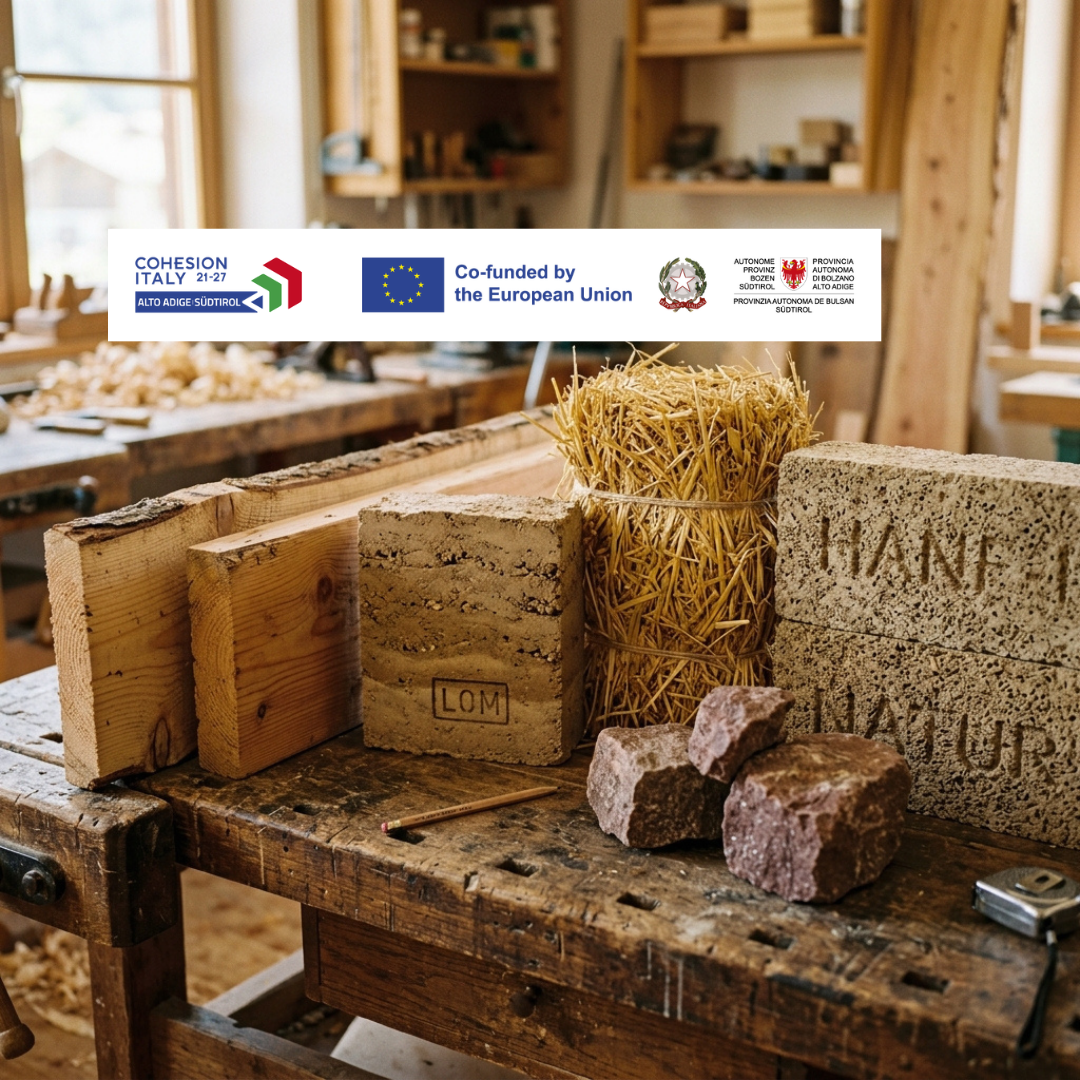
For MH1, a glue-free timber frame wall system will be developed and tested, while MH2 will serve to test an innovative mixture of clay and locally sourced wood shavings, a by-product of the regional economy. This material has the potential to replace cellulose insulation, which is typically purchased and sometimes transported over long distances as a sustainable alternative.
The possibility of constructing interchangeable and upgradeable modules is consistent with best practices in circular design adopted by industry, including design for upgradability, modular design, and design for reuse. The modular houses also function as transdisciplinary real-world laboratories where, in addition to testing and research activities, practical experiments are carried out under real-life conditions. Among other activities, the MHs host prototypes for innovative interior design solutions that were previously developed in collaboration with regional companies using locally sourced materials, some of which are derived from production waste streams.
Public perception of the construction methods implemented in the two MHs is assessed both directly within the houses, which serve as real-world laboratories, and through digital models (BIM and VR models). Throughout the project, workshops and participatory activities organized in the real-world laboratories will help raise awareness among different target groups about sustainable construction practices and the use of sustainable local materials.
The project combines and systematizes various evaluation approaches for the tested products, ranging from energy performance and user perception to ecological and social sustainability, thereby enabling a holistic assessment of the architectural project. Through the development and testing of sustainable and recyclable construction methods and interior design solutions, the project aims to support innovative and sustainable economic processes and foster further transformation towards a circular economy and sustainability within South Tyrol's business environment.
Project Objectives
- Development, implementation, and critical evaluation of two recyclable building systems, assessed in terms of indoor environmental quality, environmental impact, and user perception, while providing empirical evidence that modularity, sustainable material selection, recyclability, healthy indoor environments, and energy efficiency are not conflicting goals but mutually reinforcing principles.
- Promotion of the local circular economy through innovative, readily applicable solutions and modular construction methods.
- Collaboration between scientific research, local businesses, and citizens to increase awareness of socio-ecological sustainability through the joint development of products and the use of the modular houses as real-world laboratories.
Principal Investigator: Ingrid Kofler, Faculty of Design and Art